
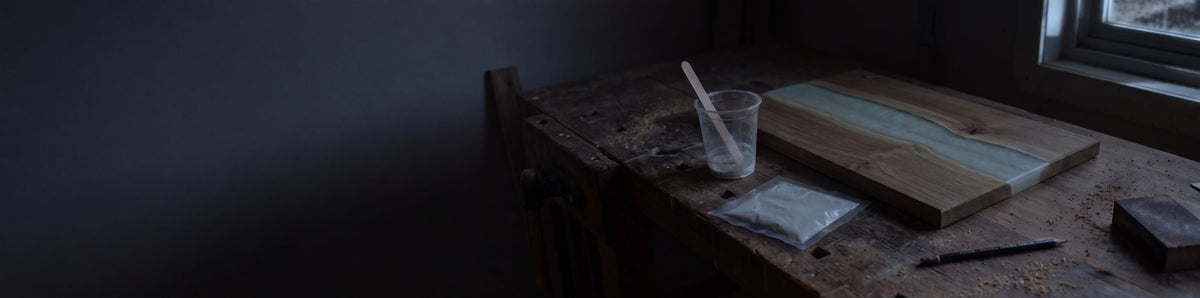
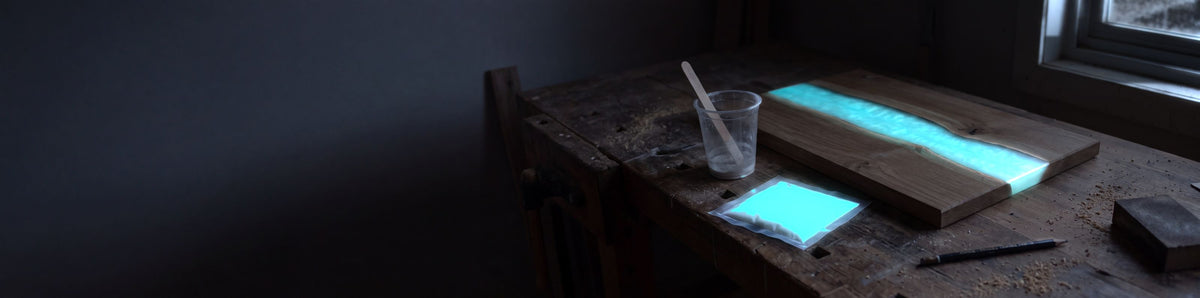
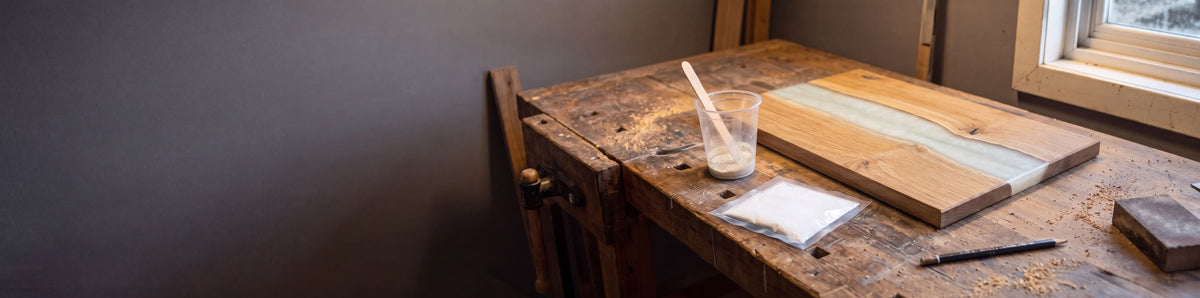


What is glow powder?
Glow powder is a phosphorescent pigment that stores light and releases it in the dark as a visible glow – without electricity and as often as you like. Almost all our powders are made of strontium aluminate doped with europium and dysprosium. Doped means that these elements are deliberately built into the crystal so that it can absorb light and release it slowly. An SiO₂ coating makes the pigment water-resistant.
Glow powder is not used on its own. It does not dissolve; instead it is stirred into a carrier and stays suspended in it. Suitable carriers include epoxy and casting resin, clear varnish, acrylic paint, glue, wallpaper paste, wax or silicone. You can also sprinkle the powder onto a sticky surface.
Which glow powder suits your project?
The right glow powder depends on two questions: how should the surface look by day, and how fine does the particle size need to be for your tools? Particle size is the diameter of the individual grains in micrometres (1 µm = one thousandth of a millimetre). As a rule, coarser grains glow more strongly, finer grains pass more easily through nozzles and screens.
| Subcategory | Particle size | Typical use |
|---|---|---|
| Glow pigments | approx. 20–150 µm | casting resin, varnish, paint, glue; whitish or coloured by day |
| Glow powder with strong daylight colour | approx. 20–30 µm | designs that should look clearly coloured by day as well |
| Glow powder with glitter | approx. 75–120 µm | decoration, resin art, nail design – sparkles in the light |
| Fine pigments | 5–15 µm | screen printing, airbrush, watch hands, DLP/SLA 3D printing |
| Powder coating | ready-made coating | powder coating of metal, glass, ceramics and clay |
Which colour glows the longest?
Pigments with a whitish daylight colour and a green, blue-green or blue afterglow glow the longest: up to 12 hours after a full charge, in complete darkness. Green is the base shade of all glow pigments. Every tint costs glow strength. We group our pigments into three levels:
| Pigments | Afterglow duration |
|---|---|
| whitish daylight colour, green, blue-green or blue afterglow | up to 12 hours |
| lightly tinted daylight colour, e.g. Yellow/Yellow-Green, Green-Green, Orange | up to 4 hours |
| White-White, darkly tinted shades such as Blue-Blue, Purple-Purple, Pink-Pink, plus natural shades with a coloured glow and Purple | up to 2 hours |
All values apply after a full charge in complete darkness. The glow is most intense in the first few minutes; after 1–2 hours it fades to a soft glimmer. Purple only charges properly with UV light. A true red is technically not possible with glow pigments.
How do you charge glow powder?
Glow powder charges with any light source, fastest with UV light and sunlight. Guide values for a full charge:
| Light source | Time |
|---|---|
| UV light from 365 nm | 2–4 minutes |
| Sunlight | 6–9 minutes |
| Fluorescent lamp | 20–24 minutes |
| Incandescent bulb | approx. 25 minutes |
Darkly tinted shades need strong light. Weak room light only excites them a little.
How to dose glow powder
As a starting point we recommend approx. 20% pigment relative to the carrier; the usual range is 10–50%. For 100 ml of clear varnish that is about 20 g. In opaque carriers such as white wall paint, use rather 30–50%. In clear carriers, more than about 30% adds little. The mixing calculator works out the amount for your project.
- Choose a carrier that is as transparent and light as possible. Dark carriers and varnishes with UV filters absorb glow strength.
- Prime dark surfaces in a light colour first.
- Stir the powder in evenly. In thin resin it sinks: let the resin thicken briefly, then stir it in.
- Test the mixture on a small sample before working on the whole piece.
Different glow powders can be mixed. However, this does not create a new shade the way mixing paint would.
Good to know: limits and safety
Afterglow is an aid for orientation and effects, not a light source. It is only visible in real darkness and barely under a street lamp.
- Heat: pure, untinted pigment withstands up to 1,200 °C. Do not process tinted pigments and glitter powders above approx. 150 °C.
- Water: the pigment is water-resistant. How weather-resistant the finished object is depends on the carrier; outdoors, use weather-resistant clear varnishes or epoxy.
- Classification: pigments and glitter powders based on strontium aluminate are not classified as hazardous under CLP. The exceptions are the orange calcium sulfide powder and the powder coating. Details are in the safety data sheets.
- Handling: the raw pigment is not a toy. When processing larger quantities, avoid dust and contact with skin and eyes.
To learn how the glow is created, read afterglow explained.