


What is glow powder with strong daylight colour?
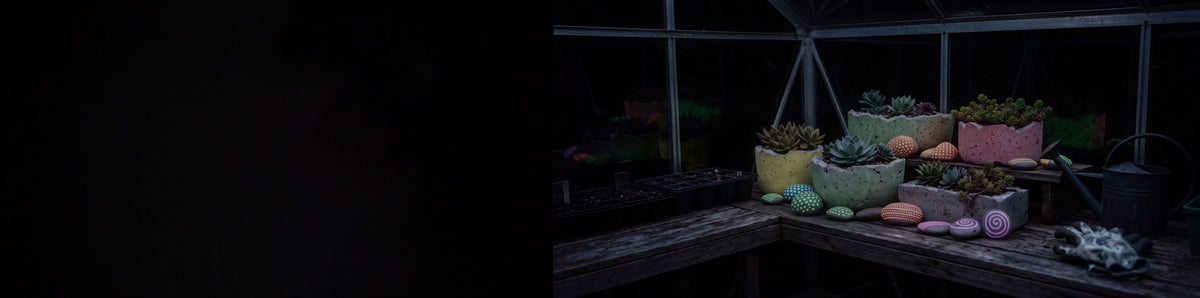
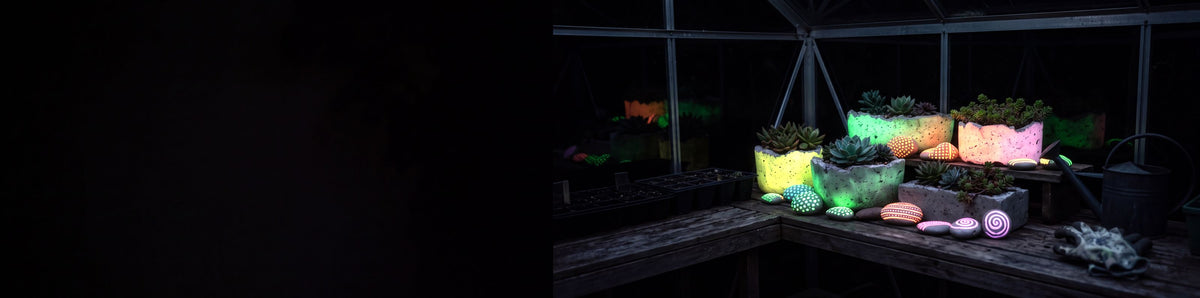
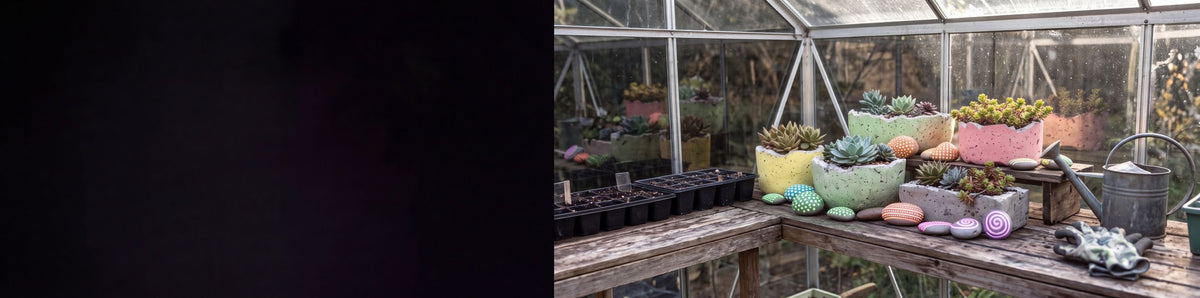
Glow powder with strong daylight colour is a tinted glow pigment: it is clearly coloured in daylight and glows in the dark after charging. Like our other pigments, it is based on doped strontium aluminate with a protective coating. The name gives the daylight colour first, then the glow colour: Pink-Purple is pink by day and glows purple.
How long do tinted pigments glow?
Tinted pigments glow for up to 4 hours (light daylight colours) or up to 2 hours (pink and purple), each after a full charge in complete darkness. Tinting costs glow strength: the darker the daylight colour, the weaker and shorter the glow.
| Pigment | by day | in the dark | Afterglow |
|---|---|---|---|
| Yellow/Yellow-Green | neon yellow | yellow-green | up to 4 h |
| Green-Green | strong green | green | up to 4 h |
| Orange | orange | orange | up to 4 h |
| Pink-Pink | strong pink | pink | up to 2 h |
| Pink-Ocean Pink | vivid pink | pink | up to 2 h |
| Pink/Rose-Red | strong pink | pink to reddish | up to 2 h |
| Pink-Purple | strong pink-purple | purple | up to 2 h |
| Purple-Purple | purple | purple | up to 2 h |
For comparison: pigments with a whitish daylight colour and a green or blue afterglow glow for up to 12 hours. You will find them under glow pigments.
When is a strong daylight colour worth it?
A strong daylight colour is worth it when your design should stand out in daylight too and the glow in the dark is a bonus. Typical uses are resin art, home decor, nail design, jewellery and candles. If the surface should stay inconspicuous by day and only show colour in the dark, the natural shades with a whitish daylight colour are a better fit. And if you want sparkle rather than colour by day, see glow powder with glitter.
How do the colours look under black light?
Under UV or black light the pigments also fluoresce: they light up as long as the UV light is on. The lighter and more vivid the daylight colour, the more vivid the fluorescence; neon yellow looks particularly vivid. You only see the afterglow once the light is off.
How to use tinted glow pigments
- Charging: darker shades such as Orange, Pink-Purple and Purple-Purple need strong light, ideally sunlight or UV. Purple barely charges in normal room light.
- Particle size: approx. 20–30 µm, fine enough for brushes, varnish and casting resin, and also for airbrush in clear varnish.
- Dosage: approx. 20% pigment relative to the carrier; the mixing calculator works out the exact amount.
- Heat: do not process tinted pigments above approx. 150 °C.
Good to know
A true red is technically not possible with glow pigments. Pink/Rose-Red glows pink to reddish, and Orange comes closest to red. Colours look different in photos depending on the camera and charge. The pigments are not classified as hazardous under CLP – see safety data sheets. The raw pigment is not a toy: when processing larger quantities, avoid dust and contact with skin and eyes.