
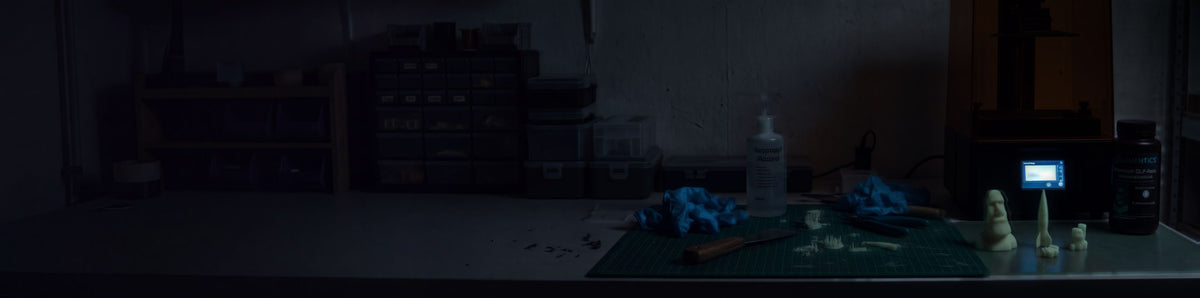
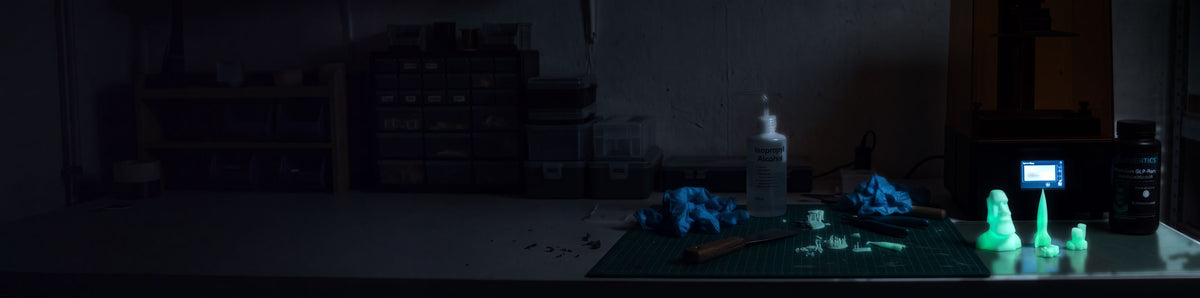
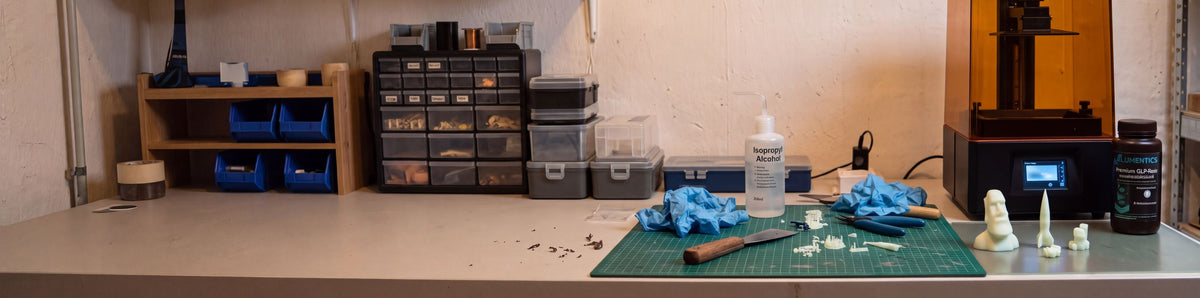


Which resin suits your project?
For resin 3D printers we offer three printing resins – glow-in-the-dark, thermochromic and clear – and, for casting by hand, an epoxy casting resin set. The right resin depends on whether you print or cast, and on the effect you want.
| Resin | Processing | Effect | Size |
|---|---|---|---|
| Glow-in-the-dark 3D printing resin (green, green-blue) | resin printer, 405 nm | glows in the dark, approx. 4 h after charging, in complete darkness | 500 g |
| Thermochromic 3D printing resin (blue/white) | resin printer, 405 nm | changes from blue to white at 37 °C, reversible; does not glow | 500 g |
| Clear 3D printing resin | resin printer, 405 nm | colourless, for tinting with colour or glow pigments | 500 g or 1 kg |
| Epoxy casting resin set | casting, resin and hardener 100 : 47 by weight | clear and UV-stabilised, carrier for pigments and granules | 1 kg resin + 0.5 kg hardener |
What is printing resin?
Printing resin is a liquid plastic that cures layer by layer under UV light inside a 3D printer. Our printing resins are made for printers with a UV light source around 405 nm. These are the DLP, SLA, LFS, LCD and LCS printer types.
All three print like standard resins. No special settings are needed: start with your printer's standard values. If the resin is slightly thicker, increase the light-off time – the pause without light between two layers – by 1–2 seconds. Keep printed objects to a maximum height of approx. 10 cm. Prints are hard with low shrinkage, and the resin has a low odour during processing. It comes in a light-protected, leak-proof bottle, and you can pour leftover resin back after printing.
Glow-in-the-dark printing: ready-mixed or tinted yourself?
There are two ways to print glowing objects: a resin with the glow pigment already mixed in, or clear resin that you tint yourself.
- Ready-mixed: The glow-in-the-dark 3D printing resin in green or green-blue prints glowing objects straight away. Green is the base shade of glow pigments and glows most strongly; green-blue has a slightly cooler tone.
- Tinted yourself: The clear printing resin is developed for stirring in glow pigments or colour pigments. As a rule of thumb, use approx. 20% pigment relative to the resin. Check the mixture with a small test print first.
Either way, the pigments are heavier than the resin and settle. Shake the bottle vigorously for at least 2 minutes before every pour. Solid areas glow more strongly than thin walls.
Colour change instead of glow: thermochromic resin
Thermochromic means the material changes colour with temperature. Prints made from the thermochromic 3D printing resin are blue and turn white at 37 °C, for example through touch or warm water. As they cool, the blue returns. This resin does not glow in the dark.
Casting resin as a carrier for glow pigments
Epoxy casting resin works as a clear carrier when you want to cast glow pigments or granules by hand, without a printer. Our epoxy casting resin set cures slowly. This gives air bubbles time to rise, and layers of up to 3 cm can be poured in one go. Mix resin and hardener at 100 : 47 by weight, for example 200 g resin and 94 g hardener. Pour thicker objects in several layers.
Use pure pigment for resin, not ready-made glow in the dark paint. Let the mixed resin thicken briefly before you stir in the pigment; otherwise it sinks in thin, runny resin. Besides powder, you can also embed glow granules. The mixing calculator works out how much pigment you need for your quantity.
Good to know: working with resin
Liquid resin is a chemical and needs protection during processing. Wear protective gloves and eye protection, ventilate well and avoid skin contact. For the casting resin set, add protective clothing. The hazard and safety information is on the containers; you will find the data sheets under safety data sheets, or we will send them on request.
And to be honest about the glow: afterglow is a visual effect and an aid to orientation, not lighting. It is clearly visible only in real darkness, and strongest in the first few minutes after charging.